
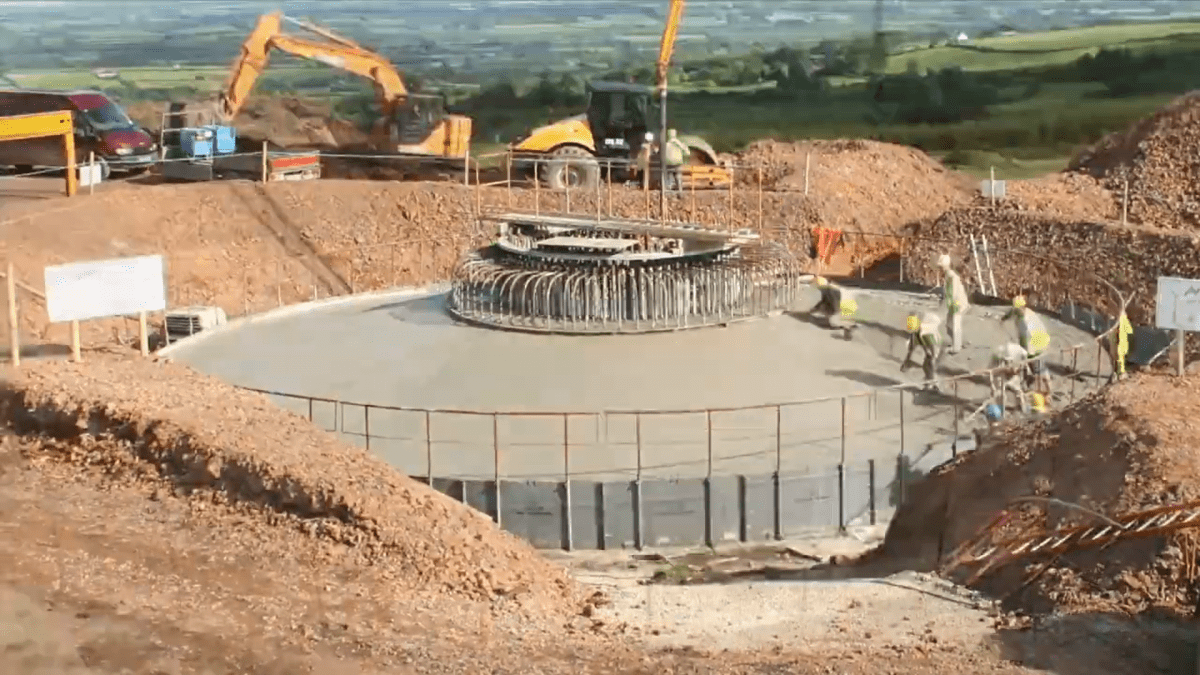
Government Policy Allows Wind Farm Developers to Abandon Infrastructure on Peatland – and Our MPs Have Nothing to Say
Rooley Moor Neighbourhood Forum has raised a serious and urgent concern with all three of our local MPs — Blundell, Waugh and MacNea — regarding the government’s environmentally damaging policy on decommissioning wind farms built on peatland. None of them has responded.
A National Policy That Permits Abandonment
The National Policy Statement EN‑3 (Renewable Energy Infrastructure) sets out the government’s approach to decommissioning wind farms. Buried in paragraph 2.12.37 is a statement so extraordinary that it demands public attention:
“The nature and extent of decommissioning of a site can vary. Generally, the wind turbines themselves will always be decommissioned with the concrete foundations in the ground dug out to a certain depth to ensure that former or new uses of the site can continue.”
In plain terms, this gives developers the opportunity to leave huge quantities of industrial infrastructure buried in peat – a living, acidic, carbon‑rich ecosystem that is chemically incompatible with concrete, access roads, crane pads and other alkaline materials.
This is not restoration. This is abandonment!
Peatland Is Not a Construction Platform
EN‑3 is written as though all wind farms sit on mineral soil. They do not. Peatlands are water‑dependent, fragile, and globally recognised carbon stores. Introducing industrial infrastructure permanently alters their chemistry and hydrology. Removing it only partially – or not at all – locks in long‑term damage.
Restoration Cannot Be Guaranteed — So Why Is It Counted in Carbon Offsetting?
Current policy also fails to recognise a basic scientific reality: peatland restoration is uncertain, slow, and often unsuccessful once hydrology has been disrupted. Any suggestion that restoration can be used to justify carbon offsetting is therefore misleading and scientifically unsound.
Restoration may be desirable if it works – but it cannot be relied upon, and it must respect long‑standing rights of common. EN‑3 does not address this.
Scout Moor II: A National-Level Failure
Cubico’s proposal for Scout Moor II – which would become the largest onshore wind farm in the UK – exposes the scale of the problem. SM1 has already caused irreversible peat loss. Without a complete rewrite of EN‑3, the same will happen again, with developers permitted to walk away leaving foundations in place.
A decommissioning bond is meaningless if the policy itself allows partial removal.
What We Asked Our MPs to Do
RMNF has formally asked Blundell, Waugh and MacNeil to raise the following points with the Secretary of State for Energy Security and Net Zero:
-
- EN‑3’s decommissioning guidance is written for mineral soils and is not fit for peatland.
- Leaving foundations in situ is incompatible with restoration and long‑term carbon integrity.
- Policy must require full removal of all infrastructure from peatland – NOW!
- Decommissioning bonds must be based on full removal, not partial excavation.
- Moorland restoration cannot be guaranteed and must not be used for carbon offsetting.
And Yet… Silence
Despite the seriousness of the issue – and despite the national implications for carbon storage, biodiversity, public finances and long‑term environmental integrity – none of our MPs has responded.
Not one.
A Policy Failure That Cannot Be Ignored
This is not a technical quibble. It is a fundamental question of whether upland peatlands – irreplaceable national assets – are protected or permanently degraded.
Government legislation is fragmented, outdated and scientifically out of step. A full review is urgently required.
RMNF will continue to press for answers. Our peatlands deserve better than silence.