Working together to protect and enhance our neighbourhood
Friends
Friends of Rooley Moor Neighbourhood Forum provide valuable financial sponsorship to help us undertake projects in our area. If you would like to become a Friend of Rooley Moor Neighbourhood Forum please get in touch via our contact page.
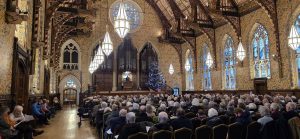
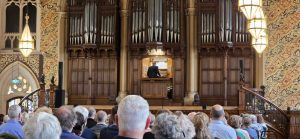
Every Wednesday at 12:30pm, enjoy the Queen’s Award-winning Toad Lane Concerts at the stunning Grade I listed St Mary in the Baum church, Toad Lane, Rochdale, OL16 1DZ.
Admission is just £6. As a “not for profit” initiative, your entry fee and donations directly support talented musicians, the historic venue, and music resources.
For details, contact Dr. Joe Dawson: 01706 648872.
Note: There have been 1,207 concerts since taking over the council’s Music at Lunchtime in 2001. Justifying continuity in Rochdale’s year as the Greater Manchester Town of Culture.
Doors open 12noon, concert starts 12.30pm – 1.30pm.
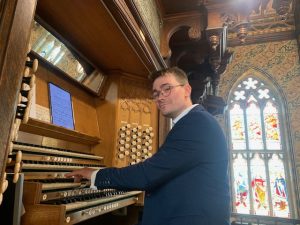
Wednesday 21st October 2026 – Lewis Kingsley Peart piano (Trinity Laban Conservatoire)
Here are the next events to whet your appetite.
Oct 28 – John Powell baritone (Cambridge Univ & BBC Singers) & Carol Kwater piano
Previous Performance Reviews.
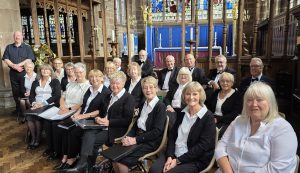
Wednesday 14 October 2026 – Oldham Community Choir conductor Jonathan Gibson & piano Edward Rigg
Oldham’s mixed voice Community Choir rehearses on Wednesday mornings in central Oldham. Formed in 1985 by an Oldham music teacher, its direction was taken over in 1995 by J Edward Rigg, a Rochdale music teacher. Currently acting as accompanist, Edward was born in Wardle. After qualifying as a teacher and with a diploma from the University of Paris, plus an LRAM, he taught in Rochdale for 18 years. Throughout this time, he has been involved in music making as a conductor and accompanist as well as a keen choral singer. He is President of Rochdale Phoenix Opera Society and organiser of the Littleborough Coach House lunchtime concerts.
The present conductor, Jonathan Gibson began playing the French horn at the age of 9 and quickly became a regular player with the county’s youth orchestra and the Northampton Symphony Orchestra. From 1993 to 97 Jonathan studied at the RNCM. Since graduating he freelances with several professional ensembles and even appeared playing his horn in the Queen’s Jubilee episode of Coronation Street. He is currently also the MD for Rochdale Phoenix Opera Society and the ladies’ choir More than Melody. He is proving to be a great asset to the Northwest music scene.
With two such experienced and capable mentors, the choir continues to entertain themselves and others, such as here at St Mary in the Baum on their annual visit.
It was curtain up with sprightly numbers ‘Another Opening, another show’ and ‘Comedy Tonight’, before contrasted serious anthems, ‘With A Voice of Singing’, and ‘Such Lovely Things’. Clearly, much care had been taken to learn singing parts and the male contingent made a fine foundation.
Show songs, ‘Getting to Know You’, ‘Oh What a Beautiful Morning’ and ‘Oklahoma’, plus 1950’s hit standards the ‘Chattanooga Choo Choo’, ‘Catch a Falling Star’, and ‘Perhaps’, culminated in a rousing ‘Joshua at the battle of Jericho’. A characterful ‘Oliver’ medley demonstrated laudable stamina, and Chorus Line’s ‘One’, meant that we could be ‘Stepping Out … putting on the Ritz’ with a final sizzling ‘All That Jazz’. There was a tune for everyone in this joyful, varied programme.
No wonder modern medicine recommends singing in a choir to beat the blues and maintain youthful vigour.
With thanks to Dr. Joe Dawson for permission to publish his article.
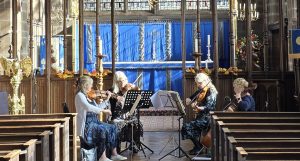
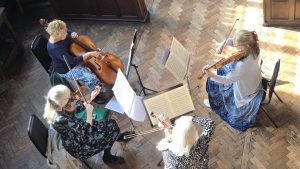
Wednesday 7 October 2026 – Seren String Quartet
This scintillating strings Toad Lane Concert at St Mary in the Baum was number 1,206 since taking over from Rochdale council in 2001.
We were blessed with an impressive lineup of four highly experienced principal string players. 1st violinist Pip Clarke (RNCM and Guildhall) gave her ‘sold out’ debut in Carnegie Hall, New York in 2007, performing the Korngold Violin Concerto with the New York Pops. Back in the UK she leads the Cheshire Sinfonia, teaches privately and conducts a ladies choir.
Violinist Sarah Snape (Dartington College of Arts, York University and the National Centre for Orchestral Studies) has played with the Bilbao Symphony, Northern Ballet Theatre and Royal Liverpool Philharmonic Orchestras, Manchester Camerata and the Northern Chamber Orchestra, including playing at The Proms.
Violist Cathrine Perkins taught violin and viola in the RNCM Junior Department and Chetham’s School of Music. Since retiring she has continued enjoying chamber music. An ardent horse rider she has recently returned from a horse safari in Zambia, she also loves bird watching.
Cellist Cathie Bunting (Royal College of Music) played with the Ulster Orchestra and the Royal Liverpool Philharmonic Orchestra where she was a founder member of the Braga string quartet and the Florian piano trio. She left after 14 years to freelance, teach and continue playing chamber music.
From the first phrases of Puccini’s Minuet & Trio of 1890 we were clearly in good hands, and this was a great curtain raiser to the main work, the sumptuous String Quartet No. 13 in A minor (the Rosamunde Quartet), D 804, Op. 29 of 1824. The second movement, Andante, has the tune of the incidental music he was writing that everyone will recognise, and the rest of the work abounds with development, wave after wave of rich string sound and elegant and refined phrasing.
The string quartet structure was established by Haydn in the 18th century as the supreme medium for a composer’s innermost thoughts. Just four solo strings, without the variety of the rest of the orchestra means that pure musical ideas must be strong enough to hold the work together. Schubert’s Rosamunde Quartet has always been a favourite for players and listeners. It requires ultimate teamwork from excellent individual players, rapport and collective interpretation. This we found in abundance. Despite the logistics and difficulties of getting four such accomplished players together, they enjoyed the marvellous acoustic of St Mary’s and the friendly audience and would love to come again … Yes please!
With thanks to Dr. Joe Dawson for permission to publish his article.
ORTOA (Oldham, Rochdale and Tameside Organists’ Association) was established in 1908. Latterly it has been made up of organists and music aficionados to support music in the area.
The organ in the town hall is renowned internationally. The committee consists of volunteers who, with the council officials, develop concerts by leading exponents to make the most of it.
Jonathan Scott is one of the leading organists of his generation and has charge of the Bridgewater Hall instrument amongst other accolades. He is the Honorary President of ORTOA and he also arranges concerts in his own right. More information at www.jonathanscott.co.uk
Saturday 31 October 26 at 3pm (note the time) the Brereton Memorial (25th Anniversary) Concert featuring Gordon Stewart.
Previous Performance Reviews.
Tuesday 15 September 26 at 1 pm Adam Wilson (York Minster)
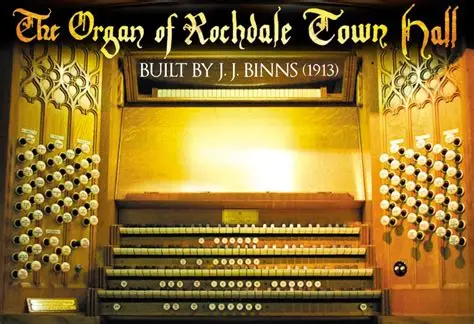
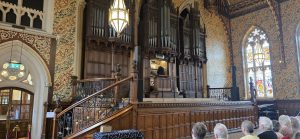
The JJ Binns instrument in the Great Hall is regarded as one of the UK’s finest civic pipe organs.
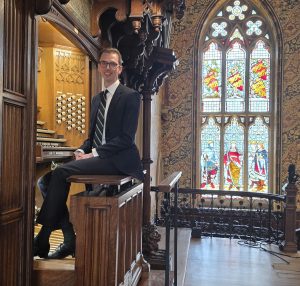
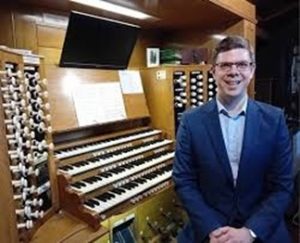
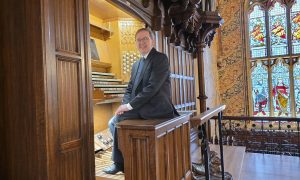
A worthy addition to the impressive ORTOA celebrity organist list today was Adam Wilson, Assistant Organist of York Minster. He plays for services and concerts, and accompanies the choirs, as well as sharing administrative responsibilities. He is particularly responsible for the Minster’s organ outreach, aimed at cultivating interest within the city, particularly for children and young adults, in the Minster’s newly restored organ.
Prior to York, Adam served at Wells Cathedral and St Mary’s Episcopal Cathedral in Edinburgh. He has also held organ scholarships at Peterborough Cathedral, the University of Glasgow, and Dunblane Cathedral (where he had started out as a chorister). So, he was well-placed to check out and cope with the challenges of a unique instrument with its partly-restored idiosyncracies; his programme of great music from Baroque to modern was well suited to the Rochdale organ.
Firstly, his own skilful arrangements of contrasting movements of Handel’s ‘Water Music’ – (i) briilliant, brassy Overture, (ii) gentle Minuet, (iii) melodious Air, (iv) lively and rhythmic Country Dance, (v) sustained and bold Adagio e staccato, and (vi) jaunty, foot-tapping Hornpipe; making full use of the orchestral combinations available to him.
Kenneth Leighton’s Lumetto: Little Canonic Variations on ‘Jesus bids us Shine’ was more contemporary and also introduced the notion of ‘canon’ (overlapping imitations of phrases or fragments) which featured in the rest of the programme.
JS Bach’s chorale prelude, Dies sind die heilgen zehn Gebot BWV 678, Luther’s versification of the ten commandments explored dozens of canonic possibilities. This was followed by a refreshingly translucent Canzonetta in E Minor, BuxWV 169, by Buxterhude, the great master who Bach is said to have walked 200 miles to hear.
Rheinberger’s Prelude & Fugue (Sonata No 10 ) with its darker tone and bigger canvas, coming from about the same period sound word as the JJ Binns itself, contrasted with the spiky, abrasive, strident tweniteth century harmony in blind C20 maestro Gaston Litaize’s Épiphanie. In further contrast Percy Whitlock’s Lantana (Plymouth Suite) was a gentle English pastoral stroll; but all styles were embraced within the faculties of the instrument.
To cap it all off Guilmant’s Final(Sonata 1 in D Minor) produced a massive climax with hands and feet turbo-charged, producing torrents of sound at blistering speed. The term ‘Canon’ by this time resounded with its military connotations: ‘Cannon to right of them, Cannon to left of them, Cannon in front of them Volleyed and thundered’ . A triumphant performance, that amply deserved the sustained applause.
With thanks to Dr. Joe Dawson for permission to publish his article.
Tuesday 14 July 2026 at 1 pm –Soloist William Campbell
Classic organ works by Vierne, Walker, Jongen, JS Bach … and All that Jazz!
The Rochdale’s JJ Binns instrument in the beautifully restored Great Hall is regarded as one of the finest civic pipe organs in the UK; it also represents a noble tradition of making music accessable to all.
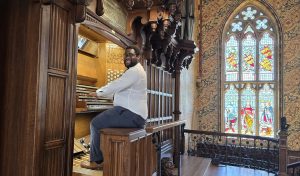
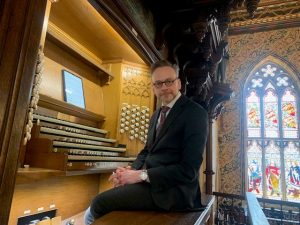
A worthy new addition to the impressive ORTOA celebrity organist list is organist, composer and conductor William Campbell, currently Assistant Director of Music at Peterborough Cathedral. He relished his time with the instrument and took on board the tradition … and us.
Born in Croydon to parents of Caribbean descent, William started the violin aged 3 and later the piano and trumpet before organ lessons aged 14 as a music scholar at Wellington College. He was soon appointed Organ Scholar and subsequently Acting Organist at St. Laurence Church, Catford in 2018; upon leaving school, he became the Organ Scholar at Guildford Cathedral.
He graduated first class from York in 2023, during which time, he held several posts including deputising at all of Yorkshire’s Cathedrals. Then came two terms as Organ Scholar at Canterbury Cathedral before returning to Leeds and Bradford Cathedrals.
Always looking for wider experiences, William played the organ with the Chineke! Orchestra at St. Paul’s Cathedral and the Royal Festival Hall, and appeared on BBC radio and television as an Organist, Violinist, Pianist and Harpsichordist; he is an FRCO, LTCL (and DipABRSM violin) and an ABRSM examiner.
He confidently introduced his imaginative programme that embraced a variety of styles.
Prelude and Fugue from Organ Symphony No. 1 in D Minorby Louis Vierne (1870-1937) the visually impaired French organist and composer of Notre Dame was a wise opener, the rich sonority of the Prelude and the lively fugue suited the characteristics of the Rochdale instrument superbly, as did William’s own arrangement of Lyric for Strings by George Walker (1922-2018) the oustanding, ground breaking African-American musician. This originated as the second movement of his String Quartet No. 1, of 1946, bearing a passing resemblance to contemporary Samuel Barber’s Adagio for Strings. Again the organ sound was terrific with its long sweeping melodies and plangent modern harmonies. Further enchantment in Prière and Choral from ‘4 Pièces pour Orgue’ by Joseph Jongen (1873-1953). Second only to César Franck as a Belgian composer, Jongen provided another harmonic feast, building to a massive climax after moments of calm.
Then a seismic shift back to Baroque harmony and counterpoint with the majestic Ricercare a 6 from ‘The Musical Offering’ BWV 1079 by JS Bach in an excellent transcription by the German expert Herbert Collum. This was from the mind-boggling collection of pieces and puzzles based on a tortuous theme given by King Frederick II ‘The Great’ of Prussia himself to challenge the creativity of JSB, who would have been delighted with the Binns’ sound, and William’s skilful playing. A memorable offering.
Time to let the hair down with Lay my Burden Down by Iain Farrington. This composer, known for his contributions to Charles III’s coronation and film music, used five African-American spirituals or traditional Plantation songs reasserting their roots of blues and jazz through facets of twentieth century styles such as Oscar Peterson-like, blistering keyboard technique and Count Basie-like big band scoring, delivered in a fluent improvisatory manner.
This recital had everything, including a solid footing with JS Bach, making full use of our civic instrument; played by a refreshing, multi-talented addition to the organ virtuoso fraternity.
With thanks to Dr. Joe Dawson for permission to publish his article.
Monday 22 June 2026 at 1 pm – Soloist Jean Martyn
That’s entertainment! With touches of gravitas.
The JJ Binns instrument in the Great Hall is a renowned civic pipe organ. It also represents a noble tradition of civic instruments in the UK that encourages the appreciation of adaptations of ceremonial, orchestral and secular music … for all.
It has extended its repertory since the restoration of the Great Hall to embrace cathedral virtuosos to accompaniments for silent movie nights (Nosferatu and the Phantom of the Opera) and cinema organ playing.
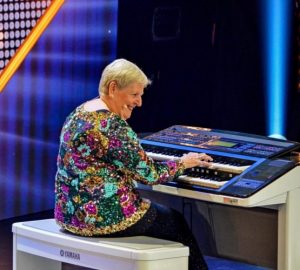
So, an appropriate and worthy addition to the impressive ORTOA celebrity organist list was Jean Martyn, an acclaimed performer on keyboards. Largely self-taught from the age of 3, she gained ATCL and LGSM and became a teacher, organist and musical director … but always an entertainer.
Jean was a finalist on Britain’s Got Talent 2011, which led to international performances, including Ronnie Scott’s in London! This added to her distinction of being the only woman to record a CD on the Wurlitzer organ in the Blackpool Tower ballroom. She also played classical organ concerts.
During the pandemic, Jean’s streaming sessions brought her music to a global audience and she continues to attract thousands of followers.
Janet established herself as an entertainer instantly, engaging with the audience and interspersing endearing tit-bits of her life story between pieces.
Once mounted at the consoles with just a few shorthand chords to remind her, Janet’s determined vitality burst forth with the appropriately named ‘I got rhythm’ by Gershwin. The noble Binns began to let its ankles show.
Janet’s programme was in effect a series of fluent extemporisations on themes that sometimes explored unusual textures: ‘Somewhere over the rainbow’ really sang plaintively, and ‘Marches on a windy day’ was a potpourrie of tunes and effects – stormy with a touch of the circus and steam organ with the Binns gleefully splashing through puddles with delight.
Classical gravitas included ruminations on a childhood piano piece, Rubinstein’s Melody in F, which provided a charming segue into a medley of West End Musicals. Janet called out, ‘close your eyes, you’re now in London.’ And do you know, we were. Tunes from West Side Story, Les Mis and Phantom emerged complete with the character of the works. Handel’s Arrival of the Queen of Sheba was at a fiendish pace, lifting its skirts cheekily before moving seamlessly into a Beatles selection.
Childhood recollections came to the fore again with improvisations on Three blind Mice exploring even more unusual registrations and slipping into heavy jazz. Elgar’s Pomp and Circumstance No 4 brought us back round to Edwardian gravitas with just a soupçon of blue harmony.
All too soon, encore time came, but had room for requests and jazz to finish.
Then, just for good measure, Janet moved to the grand piano at the side of the stage to deliver the Warsaw Concerto!
A great entertainer that gave enormous pleasure. The impressive Binns wore its sunhat well.
Next concert Tuesday 14 July 2026 at 1 pmWilliam Campbell (Bradford Cathedral).
Admission £10 (concessions £8) concerts last one hour. Card or cash at the door or visit www.rochdaletownhall.co.uk/events or iao.org.uk/ortoa.
With thanks to Dr. Joe Dawson for permission to publish his article.
Previous ORTOAPerformance Reviews.
Tuesday 19 May 2026, 1 pm – Alexander Woodrow (Leeds Minster)
Alexander Woodrow was appointed Organist & Director of Music at Leeds Minster in 2020. He leads a busy professional life as a choral director, church musician, organ recitalist, and teacher. He is Director of Music for two chamber choirs and Accompanist to the Yorkshire Philharmonic Choir.
Alex has held positions at Guildford and St Albans Cathedrals, Hexham Abbey, and from 2012 to 2016 was the youngest cathedral organist in the country, as the Organist & Director of Music at Bradford Cathedral.
Alex read Music as Organ Scholar at Magdalene College, Cambridge. He became a Fellow of the Royal College of Organists at the age of 19, winning first prizes in all categories, including the Limpus Prize. He is also a Fellow of Trinity College London, and a recipient of the Silver Medal of the Worshipful Company of Musicians. Alex has regularly broadcast as both conductor and organist on BBC Radio and Television with the Choir of Bradford Cathedral, Solihull School Chapel Choir, and the Choir of Leeds Minster. He has been Organist to five programmes of BBC Songs of Praise and directed the music for the BBC1 Easter Sunday Eucharist from Leeds Minster in 2022.
His forthcoming programme for Rochdale’s magnificent JJ Binns instrument is well chosen, with works by William Walton, Percy Whitlock, Philip Moore, Mendelssohn, Samuel Coleridge-Taylor, Alfred Hollins and Saint-Saëns.
Come and see a Master at work.
With thanks to Dr. Joe Dawson for permission to publish his article.
ORTOA tour of Middleton – Saturday 14th March 2026
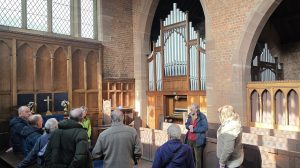
In a week when there was much media attention to pipe organs becoming an endangered species, organists were at large in the borough – Middleton to be precise.
ORTOA (Oldham, Rochdale and Tameside Organists’ Association) has been supporting organ music in the area since 1908. They promote concerts, particularly the Rochdale Town Hall organ, where they even managed to present a recital in between ‘tiers’ during Covid when the rest of the country was silent! But they have also promoted others throughout their patch, particularly when the town hall was closed for restoration.
St Leonard’s Parish Church
Members also enjoy periodic ‘organ crawls’ where significant instruments are explored, scrutinised and played during a Saturday outing.
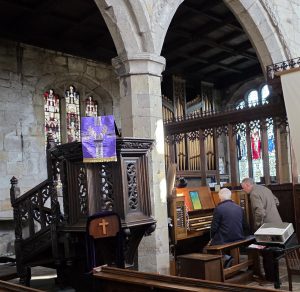
The latest of these ‘crawls’ was around Middleton, where the Parish Church (St Leonard’s, Grade 1 listed) has a truly notable historical presence high above the town since its ancient foundation in 1412. It also has a tremendous musical heritage, including an organ, which members relished trying out (1920 Rushworth & Dreaper; rebuilt 1965 by Pendlebury Organ Company, 3 manuals plus pedal with 30 speaking stops). Leon MacLeod proved be a genial encyclopaedic guide to the historic building and its fascinating contents; resident organist David Brocklehurst also advised and demonstrated.
A short stroll through the Jubilee Park led to the Long Street Methodist Church complex – church, school and lecture hall set around a garden (1899-1901) – a fine Arts and Crafts masterpiece by renowned local architect Edgar Wood (1860-1935), hosted by Christine Grime. The organ needs some renovation and care but is an interesting reminder of the variety of instruments suited to their surroundings (original Peter Conacher & Co, Huddersfield, overhauled 2002, 3 manual and pedal with 23 speaking stops).
Long Street Methodist Church
Following a tasty repast next door at the Old Boar’s Head Pub (1622) the intrepid organists rounded off their crawl at the more recent St Michael & All Angels, Tonge, which was financed mainly by local brewery JW Lees, begun in 1901 and completed in 1931.
Members were delighted with their Middleton tour; as one of them said, ‘It brings to life the richness of heritage around us that we drive through day by day, wearing blinkers.’
New members are always welcome, contact Barrie Brailsford on 01706 343163.
With thanks to Dr. Joe Dawson for permission to publish his article.
Concert at Rochdale Town Hall Saturday 28 February 2026 – Ronny Krippner (Ripon Cathedral)
Dr Ronny Krippner was appointed Director of Music at Ripon Cathedral in 2022. Born in Bavaria in 1980 he studied organ in Regensburg while at the same time working as Assistant Choirmaster of the ‘Regensburg Cathedral Sparrows’, the Cathedral’s famous boys’ choir.
He took his master’s at Exeter University UK whilst singing in the Cathedral Choir as a Choral Scholar. In 2005 he became Organ Scholar at Bristol Cathedral, Organist at Clifton College and a member of staff at Bristol Grammar school. After a period at Newport Cathedral, Ronny held several such posts in London.
Ronny has made organ improvisation a specialism, for which he has won many accolades; he was Specialist Tutor for Organ Improvisation at the Royal Birmingham Conservatoire and in 2019 gained a PhD with a thesis on the subject from Birmingham City University. Ronny has recorded several CDs with organ and choir music and performed on television and radio in Germany and the UK.
So, Rochdale’s magnificent JJ Binns instrument was in good hands (and feet). In his pithy and helpful introductions Ronny described it as ‘absolutely amazing.’
Guilmant’s Finale from Sonata No 1 was a splendid opening, quickly establishing both player and the composer’s late Romantic style ideal for the instrument.
Mozart’s only surviving piece for organ, Piece for a Musical Clock K594 was mainly sombre and reflective as it was a funereal piece, yet Mozart’s playfulness and Classical charm surfaced for moments such as with references to his comic opera Cosi fan tutte.
Stanford’s Fantasia and Toccata in D minor, brought us back to the late Romantic sound world as with pieces from Widor’s Symphonie Gothique Op 70.
Finally, Ronny’s own improvisations provided a tantalising glimpse of the art of the organist. Not only must they adapt quickly to each individual instrument’s foibles but be quick witted enough to extend or provide seamless musical accompaniments to the needs of the church service or occasion. He showed himself to be a master of this with his Thema and Variations on Handel’s March from Scipione, and Prelude, Adagio and Fugue on the tune MELITA (Hommage à JS Bach).
This programme proved to be a perfect match for player, instrument, venue …and audience, as the sustained applause that called him back to the stage demonstrated.
With thanks to Dr. Joe Dawson for permission to publish his article.
Concert at Rochdale Town Hall Saturday 31 January 2026 – Peter Kwater
Peter Kwater was born in Blackburn and became seriously interested in music at the age of 16, and went on to study Organ, Piano and Harpsichord at the RNCM with Ronald Frost and Gillian Weir.
Following graduation and two years as Organ Scholar at Liverpool’s Metropolitan Cathedral, Peter established his own teaching practice, combined with solo performing and accompaniment work, for which he is in great demand.
Peter has been choral director and accompanist with many local Northern choirs, such as St Helens Choral Society, as well as a teacher and accompanist for Wigan Music Service. He was Organist and Director of Music at St Bartholomew’s Rainhill, for 35 years and since January 2024 Director of Music at St George the Martyr, Preston, with its historic 1860’s Fr Willis organ!
He wittily referred to his programme as, ‘A Full English’ as he chose such composers, many of whom lived and worked through the ‘civic’ period of entertainment through organs just like the Rochdale instrument. It was also thoughtfully varied – an eclectic mix – and admirably suited to show off the town hall instrument’s characteristics. His wife Carol was the registrant and aided his page turning with their synchronized electronic tablets – a first for the town hall’s JJ Binns instrument.
He opened with Pean – A song of triumph by Soorjo Alexander William Langobard Oliphant Chuckerbutty, (London-born of Indian parentage) a.k.a. simply Oliphant Chuckerbutty or Wilson Oliphant – worth putting on any programme, for the name alone! A triumphal opener indeed, written by a composer who was a significant expert on church, theatre and cinema organ music and playing.
Continuing this theme, after an impressive display of full power, Peter explored solo orchestral colours and sweeter sounds in two characteristic pieces, Fountain melody and Chanson d’Espoir by John Arthur Meale (b. Slaithwaite 1880-1932) who combined his ecclesiastical work at London’s Westminster Central Hall with over 600 civic performances including Saturday Popular Concerts – not unlike today.
Another contrast came with modern styles in Processional by Grayson Ives (Oxford organ scholar and an original Kings Singers member); followed by a delightful Canzona in Bb by the blind from birth musician, William Wolstenholme (b. Blackburn,1865-1931).
Two more attractive pieces by Nicholas Choveaux (b. Bromley 1909-1995) led to the resounding Triumphal March – by another renowned blind organist, Yorkshire composer Alfred Hollins (nicknamed ‘Alfred the Great’ by WT Best). Beginning and ending in triumph a carefully planned and well executed demonstration of civic organ music on one of the best surviving instruments in the country.
A charming little encore by William Russell, with its Early Romantic clarity, refreshed and enriched the palate to complete a rich and varied ‘Full English’.
The event was tinged with sadness with the news that Manchester-born Nigel Ogden, renowned organist and presenter of BBC Radio 2’s popular series ‘The Organist Entertains’ for over 38 years, passed away suddenly on the morning of last Tuesday 27th January, aged 71. He would have loved it.
With thanks to Dr. Joe Dawson for permission to publish his article.
Concert at Rochdale Town Hall Wednesday 17 December 2025 – Jonathan Scott Christmas Organ Concert
This was not just any Christmas concert. This was a Jonathan Scott organ spectacular especially for the season … and there was no room at the inn.
In what has become an annual tradition, once more the Great Hall was packed out, having been sold out several weeks previously. If you missed it, you could view it on their Scott Brother Duo YouTube channel, which attracts 100 million views.
Over one hundred years ago this magnificent instrument by James Jepson Binns (donated by Alderman Sir Samuel Turner JP) made its debut on the visit of their Majesties King George V and Queen Mary, 9th July 1913. Paying tribute to it, Jonathan commented that it was an outstanding instrument in an equally outstanding building.
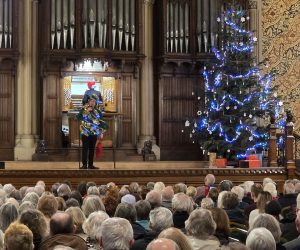
Trained at Chetham’s and the RNCM, USA and the Netherlands, Jonathan is now Associate Artist of the Bridgewater Hall and a top-class organ virtuoso. He also has a busy international concert schedule with his pianist brother, Tom (who filmed today’s show and also appeared as a six-foot Christmas tree).
Jonathan is one of those rare performers who has consummate ability and a popular touch able to engage readily with an audience. He skillfully introduced and guided us through the varied orchestral sounds and combinations at his disposal. He has played the Binns instrument many times. He affectionately remembered as a young student paying 50p per hour to practise and later notably made a definitive video recording of playing it just before the pandemic.
We started straight in with the first of Jonathan’s skillful arrangements of well-known orchestral pieces by Tchaikovsky, Saint-Saens, and his own Prelude and Fugue on Good King Wenceslas. Then his adaptations of JS Bach’s Jesu, Joy of Man’s Desiring, and Humperdinck’s Evening Prayer from Hansel and Gretel, Adam’s O Holy Night, and finally Jonathan’s own Christmas Rhapsody.
They treated us to the bonus of a Musical Christmas Crackers game, trimmed down from last year where Jonathan played a well-known classical work which acts as an accompaniment or counterpoint to a carol – audience members had to name both. The hilarity and fun belied the considerable skill of the organist to combine these themes convincingly.
For organ and music lovers, there could not have been a better Christmas gift.
With thanks to Dr. Joe Dawson for permission to publish his article.
Concert Saturday at 3 pm October 11th – 2025 Brereton Memorial Concert featuring Darius Battiwalla.
The Brereton Memorial Fund (breretonfund.org.uk) was founded in memory of Philip and Gwen Brereton who died in December 2000. Throughout their lives they were volunteers for ORTOA, the Royal College of Organists and the Incorporated Association of Organists, where they organised the Annual Congress.
Darius Battiwalla took up the post of Leeds City Organist in 2017, programming the very successful Town Hall recital series and giving regular solo concerts. He is currently overseeing the renewal of the Leeds Town Hall organ. Recent performances include the recitals at the Cathedrals of Coventry, Lincoln, Ripon, and St Albans, as well as appearances with Collegium Vocale Gent in Ghent and Amsterdam, and the annual recital for the Royal College of Organists conferment of diplomas. In 2024 he was part of the premiere of a new work for four organs by James Wood commemorating the Great Storm of 1674, to be performed simultaneously by organists across Europe. He has recently released a CD, recorded by audiophile label Base2 Music, including the Whitlock Sonata and works by Fela Sowande and Percy Grainger. He has appeared as soloist with the Halle and London Philharmonic Orchestras, and is a regular orchestral organist and pianist for the BBC Philharmonic and Halle orchestras. As a pianist, he gives regular chamber concerts with members of the Manchester orchestras, and on the harpsichord he has played continuo with many UK orchestras and performed and broadcast harpsichord concertos: most recently soloist in Frank Martin’s Harpsichord Concerto for the Northern Ballet Theatre.
Darius teaches improvisation at the Royal Academy of Music and is teaching on this year’s Royal College of Organists summer course.
He promises a tantalising Programme:
Guilmant: Sonata 1 in D minor
Bach: Pastorale
Fela Sowande: Kyrie
Mendelssohn: “Prelude & Fugue” in E minor
Hollins: 3 pieces: Intermezzo; A Song of Sunshine; A Trumpet Minuet
Chaminade: Pierrette (Air de ballet)
Bizet: Farandole from l’Arlesienne
With thanks to Dr. Joe Dawson for permission to publish his article.
Tuesday 16 September 2025 at 2 pm -Alex Fishburn.
Alex Fishburn who remembered with affection playing here ten years previously, as a teenager. His enthusiasm was clear in his performance and introductions, which resulted in him saluting the instrument. It was great to see the promise of youth coming to fruition in his masterful playing.
From 2003 Alex was a chorister at Durham Cathedral, studying the piano and, in his final year, organ. He continued at Chetham’s School of Music before studying at the Royal College of Music. He has held many positions including Sub-Organist of Liverpool Cathedral.
Now a freelance musician, he combines his work at Henry Willis & Sons with concerts and accompaniment work around the North-West.
Outside of music, Alex’s interests include change-ringing, history and architecture.
He suited his programme to Rochdale’s renowned instrument well – Elgar’s mighty Sonata in G (Opus 28) received poor reviews at its first airing but in the Great Hall’s splendour the JJ Binns’ ‘mighty beast’ revealed its true glory. A majestic Allegro Maestoso got everyone’s attention, followed by a more relaxed and tuneful Allegretto. The Andante Espressivo had broad sweeping melodies so typical of the later Elgar whilst the Presto was brisk and jaunty.
Robert Schumann’s Four Sketches for Pedal-Piano (Op. 58) were interesting adaptations for organ of music for the unusual pedal-piano that explored colourful registrations.
Two wonderful numbers by Alexandre Guillmant followed from his Opus 15, the attractive Interlude in F and March on a Theme by Handel, making full use of the orchestral colours of our civic instrument.
Pierre Cholley’s Rumba sur les Grands Jeux was a riotous foot-tapper and its vigorous development of the countermelody steamed close to the fairground. Great fun.
An extra treat, dedicated to an old friend, the late David Birch, an ORTOA committee member, A Song of Sunshine by Hollins proved a poignant encore.
Given his association with the instrument and ORTOA, not to mention his fine playing, Alex was a highly appropriate performer to round off a successful mini season of Tuesdays at One!
Keep an eye on future times and days when the town hall and ORTOA find the best fit amongst so many other fantastic events at the town hall.
With thanks to Dr. Joe Dawson for permission to publish his article.
Wednesday 23 July 2025 at 2 pm -Jonathan Scott Summer Organ Spectacular.
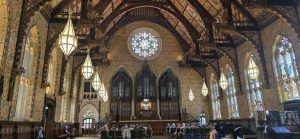
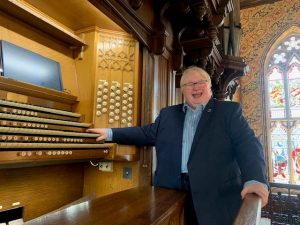
If anyone deserves the title of superstar in the world of organ music, it is Jonathan Scott. As shown in the picture, the hall was packed at 2 pm on a Wednesday afternoon in July.
Trained at Chetham’s and the RNCM, USA and the Netherlands, Jonathan, now Associated Artist at the Bridgewater Hall also gave a live organ solo BBC Prom last year at The Royal Albert Hall.
What is more, Jonathan is one of the best players to present a programme that makes the most of Rochdale’s JJ Binns instrument, as he knows it so well and he is a skillful arranger choosing appropriately from a wide repertoire. He is one of those rare performers who has consummate ability and a popular touch able to engage readily with an audience. He skillfully introduced and guided us through the varied sounds and combinations at his disposal.
We began with Elgar’s Pomp and Circumstance March no. 4 using all of the instrument’s orchestral qualities. Followed by Handel’s Passacaglia from Suite No. 7, with the original harpsichord music adapted to great effect. Then the Italian countryside was gloriously painted, complete with a convincing storm, in Vivaldi’s Summer concerto from the Four Seasons. In contrast, we had the calm of Saint-Seans’ beautiful aria from Samson and Delilah.
Mendelssohn’s Scherzo from A Midsummer Night’s Dream and Holst’s Jupiter from the Planets again revelled in orchestral colour, epitomizing the town hall organ’s capacity to bring the sounds of the concert hall or opera house to the people.
More Handel, from his Ode for the Birthday of Queen Anne also gave Jonathan the opportunity to point out the stained-glass portraits of British Royalty that surround the Great Hall, commenting that we had an outstanding instrument in an equally outstanding building.
The magnificent Widor Toccata crowned it all, incidentally, the only piece that wasn’t arranged by Jonathan.
An exquisite rendering of Puccini’s aria O mio babbino caro was a well-deserved encore that made a summer spectacular in so many ways.
You can see him again on 17 December 2025 for his Christmas offering. Book now to be sure of a place!
Jonathan is also the Honorary President of ORTOA (Oldham, Rochdale and Tameside Organists’ Association founded 1908) who continue their mission to promote organ music and the town hall instrument next on Tuesday 16 September at 1 pm Alex Fishburn (Liverpool Cathedral).
With thanks to Dr. Joe Dawson for permission to publish his article.
Tuesday 15 July 2025 at 1 pm – LEE LONGDEN Cinema Organist.
Rochdale’s internationally renowned Binns organ at the town hall was the star of the show in this delightful showbiz concert.
Lee Longden, a classically trained organist, pianist and conductor, branched out into jazz and popular music, and enjoyed a professional career as a performing musician and Musical Director. His work took him to many parts of the world, performing on land and at sea, in concert halls, theatres and cabaret and broadcasting on radio and television.
Lee returned to his first love today as a concert theatre organist after recovering from an illness. His engaging and enjoyable programmes are widely appreciated for their accessibility, variety and quality. Today was no exception.
He was delighted to have been invited to demonstrate Rochdale’s renowned civic organ’s great versatility. He said that he ‘believed the Binns turns its hand to anything’!
Although it does not have the bells and whistles or sound effects of a mighty Wurlitzer, nor does it rise through the floor, Lee used his considerable theatre and cinema skills to orchestrate imaginatively and make the most of the amazing instrumental colours and terrific bass stops. The musical choices and introductions were equally witty.
It was a case of no business like show business as famous Studio marches instantly propelled us into the world of cinema. Shirley Bassey’s Greatest Hits (entitled Shirley is Forever, as in Diamonds, get it?) had great rhythmic vitality and stirring bass and, A Walk in the Black Forest, and a Bossa Nova Selection had everyone’s feet tapping involuntarily. A Celebration of Sammy Davis Jr demonstrated superb vocal phrasing worthy of the legendary singer.
If the showbiz style was Reginald Dixon, then Lonely Ballerina was pure Mantovani and his exotic singing strings; twentieth century light music in glorious technicolour. Hollywood Blockbusters themes came thick and fast: A Bridge too Far, Pirates of the Caribbean, the Odd Couple, Born Free, Titanic, Harry Potter, the Magnificent 7, reliving those iconic cinematographic thrills. All we needed was the popcorn and interval choc ice.
This feast of movie magic came from the same musician and instrument just as capable of the gravitas of sacred or serious music of JS Bach or Widor’s Toccata – no wonder organists want to come and play Rochdale’s JJ Binns organ, a beacon of Greater Manchester’s Town of Culture 2025/6.
The sustained spontaneous applause from a delighted audience proved that this was an hour to remember – when the majestic giant clicked its heels.
With thanks to Dr. Joe Dawson for permission to publish his article.
Software development, information technology and process engineering consultants.
Mimica is a family team providing software development, information technology and process engineering consultancy. Our background includes physics and chemical engineering research.
We have a wealth of experience working in the private and public sectors, including major european projects with large groups of blue-chip companies and leading universities.
Our skills include extensive hands-on consultancy and significant commercial capabilities taking complex software products to market.
We are based in Rochdale and are able to undertake assignements with occasional travel throughout the UK and overseas.
Peers Clough Packhorses are based at Peers Clough Farm in the Rossendale Valley in the South Pennines.
We believe that working with horses and riding outdoors is beneficial to the physical, mental and emotional wellbeing of everyone.
We seek to increase knowledge, understanding and enjoyment of our natural environment in an atmosphere of mutual trust, respect and friendship between horse and rider.
Peers Clough Farm is a 200 year old, former dairy farm, set in 70 acres of pasture and woodland, between Lumb and Water in the Rossendale Valley, East Lancashire, close to the towns of Rawtenstall and Burnley.
Peers Clough Farm provides bed and breakfast accommodation and a self-catering cottage.
Ideal for visiting the area for recreation, business, family occasions, and riding, cycling or walking the Mary Towneley Loop of the Pennine Bridleway.
A quiet and peaceful location within easy reach of the motorway network it offers the best of both worlds between town and country.