
Midweek Musical Delight at St Mary in the Baum!
Every Wednesday at 12:30pm, enjoy the Queen’s Award-winning Toad Lane Concerts at the stunning Grade I listed St Mary in the Baum church, Toad Lane, Rochdale, OL16 1DZ.
Admission is just £6. As a “not for profit” initiative, your entry fee and donations directly support talented musicians, the historic venue, and music resources.
For details, contact Dr. Joe Dawson: 01706 648872.
Note: There have been 1,212 concerts since taking over the council’s Music at Lunchtime in 2001. Justifying continuity in Rochdale’s year as the Greater Manchester Town of Culture.
Doors open 12noon, concert starts 12.30pm – 1.30pm.
Wednesday 24th November 2026 – Imogen Garner mezzo soprano (RNCM) & John Gough piano (former RNCM staff)
Here are the next events to whet your appetite.
-
- Dec 02 – Telemann Baroque Ensemble: Alastair Roberts flute Elaine da Costa & Sarah Snape violins, John Goodstadt viola Rosy Hickman cello Robin Shakespeare harpsichord
- Dec 09 – Liana Storey piano
- Dec 16 – Notability Choir
- (Reopen 2027 with concert No 2,217)
- Jan 07 – More than Melody Ladies’ Choir
Previous Performance Reviews.
Wednesday 18 November 2026 – The Kell Wind Trio: Alastair Roberts (flute) Penelope Bisby (clarinet) Alex Kane (bassoon)
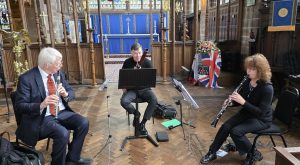
It was a welcome return by a terrifically talented trio of woodwind players. Founded in 2015, The Kell Wind Trio delivers accessible music of many assorted styles and genres. Named after Reginald Kell, the first clarinettist to use vibrato in orchestral concerts, the current members are leading players on the northwest music scene. Flautist Alastair Roberts won a Junior Exhibition to the RNCM and then graduated from the main college after four years of study. He is the principal flute of several groups including the Telemann Baroque Ensemble. Clarinettist Penelope Bisby also studied at the RNCM and has worked freelance and taught woodwind. She is also a viola player and enjoys choral singing (she aims to sing at every English Cathedral – 28/42 so far!) Alex Kane studied at the Royal Military School of Music in London, winning the “Cousins Memorial Instrumental Prize”. At age 20 he was principal bassoon of the Royal Artillery band and orchestra before joining the police service. In 2012 he retired from the service and has since returned to music.
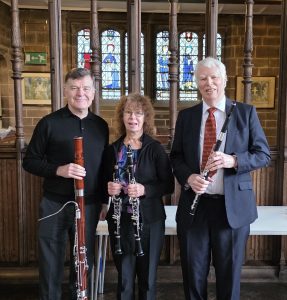 The three musical musketeers began with Diversions by Haydn and Bernstein, cleverly rearranged for the trio as, indeed, was the whole programme – a great feat of reductionism from full orchestra/band down to three players! And a further feat to deliver the overall musical effect! … thanks Alastair.
Divertimento in Bb (“St. Anthony”) by Haydn was notably reduced from dozens of players; again, testament to the trio’s stamina because normally they would have had some bars rest! Their skill and stamina maintained the spirited mood. Similarly, Divertimento – Waltz by Bernstein was also challenging in 7/8 time in homage to Tchaikowsky’s famous waltz in 5/4 time!
More foot-tapping came with March Miniature Viennoise by Kreisler, Tango by Norris and Charleston by Hallam, all bringing out the urge to get up and move. Similarly with the English Folk Song Suite of 1923 by Vaughan Williams with just a few of the 800 folk tunes he took down before they nearly disappeared. Three Scottish Dances Op.59 of 1957 by Oscar winning composer Malcolm Arnold were tuneful and witty (including a tipsy bassoon!) Finally, reminiscent of the Last night of the Proms, Fantasia on British Sea Songs (1905) by originator Henry Wood himself.
A hugely enjoyable concert which was also appreciated by Year 10 Music students from Heywood’s Holy Family RC & CofE College and hopefully inspired musicians and dancers of the future.
With thanks to Dr. Joe Dawson for permission to publish his article.
Wednesday 11 November 2026 – Nina Savecevic concert pianist (RNCM)
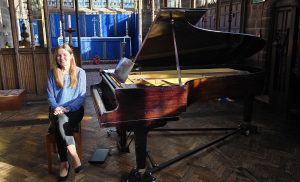
Nina attended St Petersburg’s Rimsky Korsakov Conservatoire and Wells Cathedral School as a scholarship student before completing her undergraduate and postgraduate studies at the RNCM, where she was the recipient of several scholarships and awards. She also won the Birmingham Music Festival, the piano category at Taunton Young Musician, and was a finalist at the Scottish International Youth Competition. Nina also founded and became the artistic director of the Topsham Music Festival in 2023.
Nina regularly performs across the UK and 2026 also saw her perform in France, Italy and Spain; she is looking forward to performing Mozart’s D minor K466 concerto in Bristol with the ISCA ensemble in 2027.
Nina engaged with her audience straight away with succinct introductions. From the doom-laden opening and pungent diminished seventh chord on the third beat of the iconic Pathétique Sonata No 8 in C minor Op13, you immediately knew you had entered the world of Beethoven, a world of dramatic contrasts and lofty ideas. The thundering bass tremolo and energetic first movement gave way to a sublime Adagio cantabile, which truly sang; before finishing with a blistering and brilliant but minor key of the final Rondo. Nina really made the most of the heritage 1935 8’Challen Grand Piano, from memory too.
We are familiar with virtuosos with robust tone and crashing drama but only the classiest players also dare to risk the soft bits. Nina showed how magical such contrasts can be.
We relaxed with two Nocturnes (E minor and C minor) by John Field, the Irish pianist-composer who ‘invented’ the form and spent most of his life in Russia. Nina delivered the texture of melody with simple accompaniment with expressive conviction.
Chopin developed Field’s nocturne (which, apparently, Field himself found too dramatic). Nina handled the more complex Nocturne in C sharp minor No 20 of Chopin with panache and excelled with her diaphanous scalic flurries. In similar vein she interpreted Scriabin’s own developments in his early Impromptu in Bb minor op12 no 2, including his late Romantic experiments … magical.
Gretchen am Spinnrade (Gretchen at the spinning wheel) was a song written by Schubert in 1814. The right hand of the accompaniment represents the distinctive perpetual spinning wheel (and underpins her flights of fancy and agony and ecstasy) and left hand imitates the foot treadle (and perhaps reality). Liszt championed Schubert’s songs and transcribed many of them for solo piano. Here he incorporates the melody with its already challenging accompaniment and amplifies the underlying emotions with often virtuoso pianism. Nina skilfully explored Gretchen’s feelings for Faust and her revery through Liszt’s emotional narrative.
Following sustained applause, we were treated to a surprisingly simple but satisfying encore, Handel’s Minuet in G minor arranged by Wilhelm Kempff, which rounded off an exquisite (and classy) recital.
With thanks to Dr. Joe Dawson for permission to publish his article.
Wednesday 4 November 2026 – Duncan Reid violin (Manchester University & RNCM) & Despina Reid violin (RNCM)
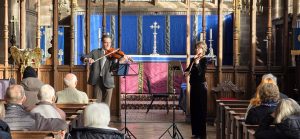
Originating from Bucharest, Romania, Despina Reid was born and raised in a musical family. She started learning the violin at the age of 5; formal musical studies began in 1990 at the George Enescu Liceé of Music. During this time, she gave numerous solo recitals across the country, and live performances for Romanian TV and Radio. In 2003, Despina won a major scholarship to the RNCM; she also performed live for Romanian TV from the Athenaeum Concert Hall. After graduating with Honours in 2007, she settled in Manchester and performs both in the UK and abroad. Despina plays on a Nicola Utili violin, made in Bologna in 1912.
Born in London and raised in Bristol, Duncan Reid began the violin under Kay Hurwitz. Many years later, Duncan attended her husband Emanual (Manny) Hurwitz’s Chamber music courses, where he was both coached by Manny and helped by him in finding the Pierre Joseph Hel violin that he plays today. Duncan studied on the RNCM and Manchester University Joint course, before playing in various Orchestras (including Opera North) and ensembles. Indeed, it was chamber music that brought the two of them together and they have been married for almost 20 years.
The duo recital from these top-class musicians was not only an exhibition of excellent violin technique and playing together, but also of the development of violin music, all of which they proved to be consummate exponents, making it look so natural!
Duet playing is a crucial part of teaching and learning the violin. Through it, music can be caught as well as taught; as with the human voice, fine tuning is paramount. However, the composers here elevated this educational approach to making great music.
The Baroque master, Jean-Marie Leclair dominated the development of violin repertoire and technique in the early C18. His Sonate V for two violins in the hands of Despina and Duncan came alive in rich tone and interesting harmony and counterpoint in the generous acoustic of St Mary in the Baum.
Likewise, the Classical period duos by ‘father of the string quartet’ Joseph Haydn extended to those of Jaques Féréol Mazas, the French Romantic violinist and composer and Director of the Paris Conservatoire. To help them bring the music off the page and into the C21 the whole programme was read from i-pads with electronic foot pedals for page turning in an impressive conflation of ancient and modern!
After such an erudite and enthusiastic survey, we had a surprise encore; not a Hoe Down (perhaps next time) but a tango – Por Una Cabeza by Carlos Gardel, a song arranged most effectively by Augustin Hadelich. Here the C20 flavours of Jazz and world music fused with seductive and persuasive rhythms. “Por una cabeza” is literally horse‑racing slang as in winning or losing ‘by a horse’s head’, here symbolizing the narrator’s similar experiences with love and temptation. These two pedigree players were definitely neck and neck all the way and way ahead of the field.
With thanks to Dr. Joe Dawson for permission to publish his article.
October 2026 Concert Reviews.
Click HERE to see the October 2026 concert reviews
September 2026 Concert Reviews.
Click HERE to see the September 2026 concert reviews
August 2026 Concert Reviews.
Click HERE to see the August 2026 concert reviews
July 2026 Concert Reviews.
Click HERE to see the July 2026 concert reviews
June 2026 Concert Reviews.
Click HERE to see the June 2026 concert reviews
May 2026 Concert Reviews.
Click HERE to see the May 2026 concert reviews
April 2026 Concert Reviews.
Click HERE to see the April 2026 concert reviews
March 2026 Concert Reviews.
Click HERE to see the March 2026 concert reviews
February 2026 Concert Reviews.
Click HERE to see the February 2026 concert reviews
January 2026 Concert Reviews.
Click HERE to see the January 2026 concert reviews
December 2025 Concert Reviews.
Click HERE to see the December 2025 concert reviews
November 2025 Concert Reviews.
Click HERE to see the November 2025 concert reviews
October 2025 Concert Reviews.
Click HERE to see the October 2025 concert reviews
September 2025 Concert Reviews.
Click HERE to see the September 2025 concert reviews
August 2025 Concert Reviews.
Click HERE to see the August 2025 concert reviews
July 2025 Concert Reviews.
Click HERE to see the July 2025 concert reviews
June 2025 Concert Reviews.
Click HERE to see the June 2025 concert reviews
May 2025 Concert Reviews.
Click HERE to see the May 2025 concert reviews
April 2025 Concert Reviews.
Click HERE to see the April 2025 concert reviews